Resume for Gulf Jobs from India: Complete 2026 Guide
You send the same resume that got you interviews in India to Gulf employers — and hear nothing back. It is not your experience. It is your CV. Here is how to rebuild it so it passes ATS and lands on a Gulf recruiter's screen.
You have five years of solid experience. In India, that resume got you callbacks. So you started applying to jobs in Dubai, Abu Dhabi, Doha and Riyadh — same CV, same numbers, better roles — and the replies just stopped. No interviews. No feedback. Silence.
Here is the hard truth: a resume for Gulf jobs from India is not the same document that works back home. The format is different, the expectations are different, and — most importantly — an applicant tracking system (ATS) reads it before a human ever does. Qualified candidates get filtered out every single day, not because they are underqualified, but because their CV was never built to pass the system.
This guide walks you through exactly how to convert your Indian resume into a Gulf-ready, ATS-safe CV — section by section, line by line — so you stop getting auto-rejected and start getting shortlisted.
Why your Indian resume fails in the Gulf
Two things are working against you, and you cannot see either of them.
First, the format. Indian resumes lean heavy: two or three pages, a photo, tables and text boxes, a dense "personal details" block with father's name, marital status and full home address, and sometimes a decorative two-column template. Recruiters in the Gulf expect something leaner and more scannable — and the ATS actively chokes on tables, columns, headers and graphics.
Second, the machine. Most mid-size and large Gulf employers, and every major job board, run your CV through an ATS first. The software parses your file into fields — name, job title, dates, skills — and scores it against the job description. If it cannot read your layout, or your keywords do not match the posting, you are filtered out before a recruiter opens their inbox. It has nothing to do with how good you are.
The candidates who get shortlisted in the Gulf are not always the most qualified. They are the ones whose CV the system could actually read.
So the goal is not to "beautify" your resume. The goal is to make it machine-readable, region-appropriate, and keyword-matched to the exact job. Let us do that.
Indian resume vs Gulf CV: what actually changes
Before we get into line-level edits, here is the big-picture difference. Print this table mentally and check your current CV against it.
| Element | Typical Indian resume | Gulf-ready ATS CV |
|---|---|---|
| Length | 2–3 pages, dense | 1–2 pages, focused |
| Photo | Often included | Leave it off (ATS + bias-safe) |
| Layout | Tables / two-column / graphics | Single column, plain text headings |
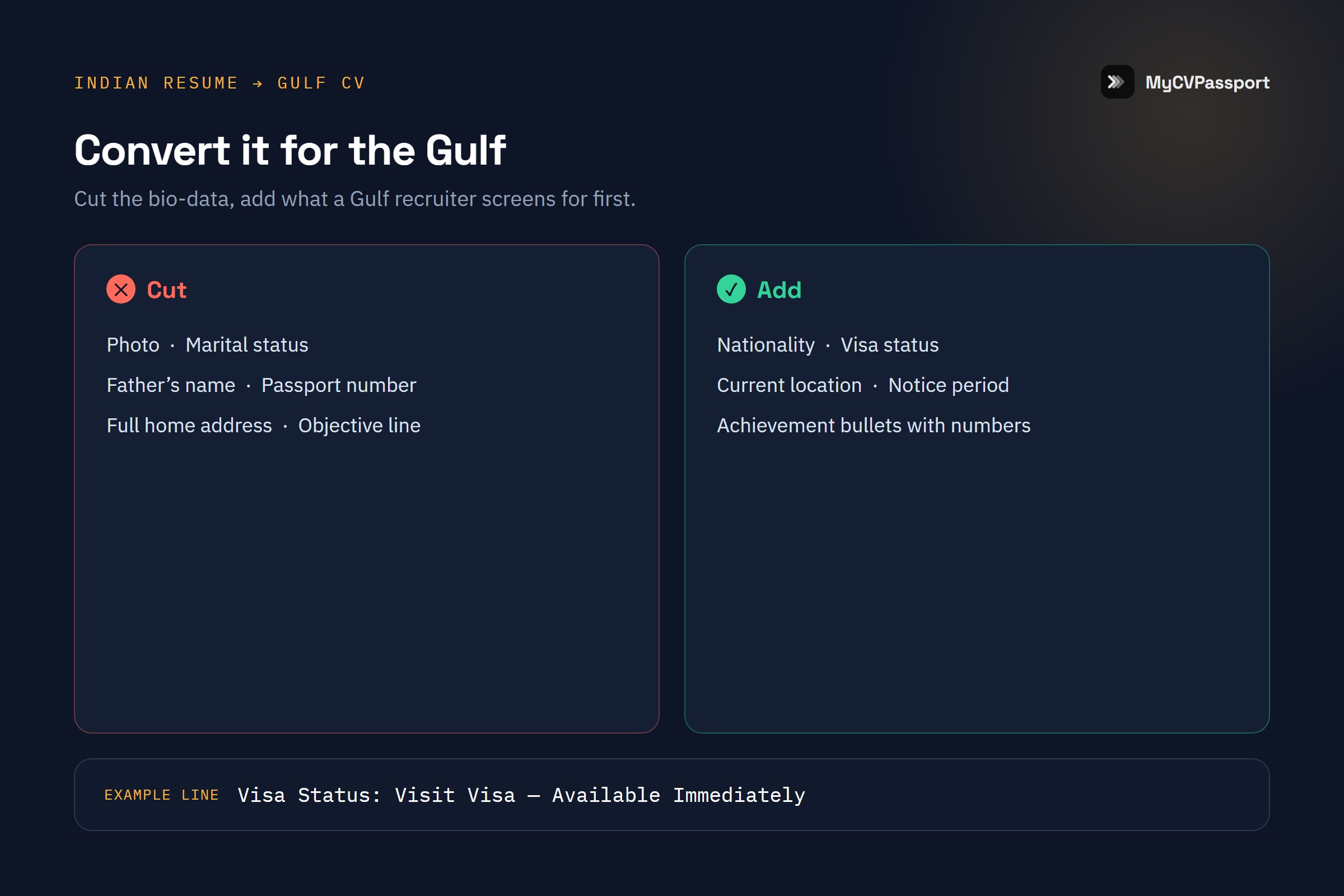
| Personal block | Father's name, marital status, full address, DOB | Nationality, current location, visa status only |
| Contact | Landline, full postal address | Mobile with country code, professional email, city |
| Objective | Long generic paragraph | 3–4 line summary, role-targeted |
| Achievements | Duties listed ("responsible for") | Quantified results ("cut X by 22%") |
| Keywords | Generic job titles | Matched to the exact Gulf job posting |
| File type | PDF from a designed template | Clean .docx or text-based PDF |
If your CV sits mostly in the left column, that is your fix list. Now let us go section by section.
The correct section order for a Gulf CV
ATS software looks for sections in a predictable order and standard headings. Do not get creative with names like "My Journey" or "What I Bring" — the parser will not recognise them. Use this order and these plain headings:
- Contact details — name, mobile with +country code, professional email, city/country, LinkedIn URL
- Professional summary — 3–4 lines, targeted at the role
- Key skills — a short list of hard skills that mirror the job posting
- Work experience — reverse chronological, quantified bullets
- Education — degree, institution type, year
- Certifications / licenses — critical for many Gulf sectors
- Personal details — nationality, current location, visa status, languages
For a deep, field-by-field breakdown of every one of these sections tuned specifically for the UAE market, read our companion piece: UAE CV Format 2026: The Complete Guide. This guide is the India-to-Gulf conversion layer on top of it.
The visa-status line: the detail that decides your CV's fate
This is the single biggest thing missing from most Indian resumes sent to the Gulf, and it matters more than you think. Gulf recruiters need to know your right-to-work situation immediately, because it affects hiring cost and timeline. If they cannot find it in five seconds, many will simply move on.
Add one clear line in your personal details block. Here is what bad and good look like:
- Bad: (nothing — no mention of visa or nationality anywhere)
- Bad: "Willing to relocate" — vague, tells the recruiter nothing about your status
- Good (currently in India): "Nationality: Indian · Location: Mumbai, India · Visa status: Requires employment visa sponsorship · Available: 30 days"
- Good (already in the Gulf): "Nationality: Indian · Location: Dubai, UAE · Visa status: On husband's/family visa, NOC available · Available: Immediate"
- Good (on a transferable visa): "Nationality: Indian · Location: Abu Dhabi, UAE · Visa status: Employment visa, transferable with NOC · Notice: 30 days"
Be honest and specific. "Available: Immediate" plus a clear visa line is a genuine advantage for candidates already in-country — do not bury it.
Rewrite your bullets: from duties to results
Indian resumes often describe responsibilities. Gulf recruiters — and the ATS keyword scan — reward outcomes with numbers. Every bullet should answer: what did you do, and what changed because of it?
Compare these:
- Bad: "Responsible for handling the sales team and targets."
- Good: "Led a 6-person sales team to 118% of annual target, adding AED 2.4M in new revenue across UAE accounts."
- Bad: "Worked on site safety and reporting."
- Good: "Cut reportable site incidents by 34% in 9 months by rolling out a daily toolbox-talk system across 3 project sites."
- Bad: "Handled patient care duties in the ward."
- Good: "Managed care for a 28-bed ward at 1:7 nurse-to-patient ratio, maintaining zero medication errors over 14 months."
Start each bullet with an action verb, put the number in, and keep it to one or two lines. If writing numbers-first bullets does not come naturally, CVPassport can rewrite them for you — the AI bullet rewrite feature turns a plain duty into a quantified, ATS-friendly line while you keep full control of the facts.
Format it so the ATS can actually read it
You can have perfect content and still fail if the layout confuses the parser. These are the format rules that matter most for a resume for Gulf jobs from India:
- Single column only. Two-column templates scramble in most ATS parsers — your skills column can end up merged into your job titles.
- No tables, text boxes or images for content. The parser skips or garbles them.
- Standard fonts — Arial, Calibri, Georgia. No decorative fonts.
- Real headings as text, not images or graphics.
- No photo. It adds nothing an ATS can read and many recruiters prefer no photo.
- Put nothing critical in the header/footer — many parsers ignore that zone entirely.
- Save as a text-based PDF or .docx — never a scanned image or a flattened design export.
This is exactly why CVPassport's templates are single-column and ATS-tested from the ground up. You get a layout that looks clean to a recruiter and parses cleanly for the machine — without you having to fight Word's formatting.
Match keywords to Gulf job boards
The ATS scores your CV against the specific job description. So a generic CV, however polished, will always lose to one tuned to the posting. Your source of keywords is the job ad itself — and the big Gulf boards make this easy.
When you find a role on Naukrigulf, Bayt or GulfTalent, read the job description and pull out the recurring hard skills, tools, certifications and job-title phrasing. Then make sure those exact terms appear naturally in your summary, key skills and experience sections — using the same words the employer used.
- If the ad says "HSE" do not only write "safety" — include "HSE".
- If it asks for "Tally ERP" and you know it, write "Tally ERP", not just "accounting software".
- Mirror the job title. If the posting says "Site Engineer — Civil", echo that phrasing in your summary.
- Include local licenses and certifications by name where you hold them (e.g. sector safety cards, professional registration).
Do not keyword-stuff or list skills you do not have — a recruiter will catch it in the interview, and it wastes everyone's time. Match honestly. The point is to make sure the skills you genuinely have are worded the way the system is scanning for.
The fastest way to know whether your keyword match is working is to test it. Paste your CV and the job description into a free ATS checker and see your score and the missing terms — then fix the gaps before you apply.
Which sectors are actively hiring Indians in the Gulf
The India-to-Gulf corridor is deep and long-running, and several sectors hire South Asian professionals in volume. In broad terms, the consistently active areas include:
- Construction and civil engineering — site engineers, QA/QC, project coordinators, planners
- Oil, gas and industrial — mechanical, electrical and instrumentation roles
- Logistics, warehousing and supply chain — coordinators, fleet and operations staff
- Hospitality and F&B — front office, service, kitchen and management roles
- Healthcare — nurses, technicians and allied health professionals (licensing-heavy)
- Retail, sales and customer service — across malls, telecom and consumer sectors
Healthcare deserves its own playbook because of the licensing and registration detail — if that is your field, read Nursing / Healthcare resume for Gulf jobs alongside this guide.
Your conversion checklist
Run your current resume against this before you send it anywhere:
- Single column, no tables, no photo, standard font
- 1–2 pages, standard section headings in the right order
- Mobile number with +country code and a professional email
- A clear nationality, location and visa-status line
- 3–4 line targeted summary, not a generic objective
- Every experience bullet quantified with a number
- Keywords matched to the specific Gulf job posting
- Saved as a text-based PDF or .docx
- Run through an ATS checker and scored before applying
Tick all nine and you are no longer sending an Indian resume into a Gulf ATS and hoping. You are sending a document built to pass.
Frequently Asked Questions
Do I need a UAE-style CV even if I am applying from India?
Yes. The employer and the ATS are in the Gulf, so your CV needs to meet their expectations regardless of where you are sitting. Applying with a home-format Indian resume is the most common reason strong candidates never hear back. Convert the format first, then apply.
Should I put my photo on a Gulf CV?
Leave it off. A photo adds nothing the ATS can read, and many recruiters now prefer photo-free CVs to keep hiring bias-safe. Use that space for a stronger summary instead.
How do I write the visa-status line if I am still in India?
Be direct: state your nationality, your current location, that you require employment visa sponsorship, and your availability. Recruiters would rather know upfront than discover it mid-process. Hiding it does not help you — it just delays the rejection.
How long should a resume for Gulf jobs from India be?
One to two pages. One page is ideal for under five years of experience; two pages is fine for senior or technical roles with more relevant history. Beyond that, you are diluting your strongest points.
How do I know if my CV will pass the ATS?
Test it. Paste your CV and a target job description into a free ATS checker to see your match score and which keywords are missing, then fix the gaps. Guessing is how qualified candidates get filtered out — checking is how you stop it.
Is CVPassport really free to start?
Yes. You can build an ATS-tested, single-column CV and run the free ATS checker without paying anything. Start there, get your score up, and apply with confidence.