Nursing Resume for Gulf Jobs from India: The ATS-Ready Guide
You have the degree, the license path and the ward experience — but your CV keeps getting auto-rejected before a recruiter sees it. Here is how to build a nursing resume for Gulf jobs from India that actually passes the ATS.
You did everything right. GNM or BSc Nursing done, two or three years on the ward, Prometric cleared, DataFlow in progress. You apply to twenty Gulf openings and hear nothing back. It is easy to assume you are underqualified. You are not.
The problem is almost always the same: your nursing resume for Gulf jobs is not built to survive the software that reads it first. Before any recruiter or nursing supervisor lays eyes on your CV, an Applicant Tracking System (ATS) scans it, scores it and files most candidates into a pile no human ever opens. Qualified nurses get filtered out every single day — not because they can't do the job, but because their CV wasn't built to pass the system.
This guide walks you through a nursing CV for the Gulf, section by section, in the exact order that recruiters and the ATS expect. Copy the examples, adapt the numbers to your own wards, and stop losing interviews you already earned.
Why a nursing resume for Gulf jobs gets rejected by the ATS
Gulf healthcare recruiters receive hundreds of applications per vacancy, often from India, the Philippines and across the GCC. To cope, hospitals and staffing agencies run every CV through an ATS that parses your file into structured data — name, license, specialty, years of experience — and matches it against the job description.
Two things break this process for Indian nurses:
- Layout the software can't read. Two-column templates, tables inside tables, text boxes, headers and footers, photos and logos. The ATS reads left-to-right, top-to-bottom. Put your license in a sidebar and the parser may skip it entirely.
- Missing eligibility signals. A Gulf recruiter needs to know in the first five seconds whether you can legally work. If your licensing and eligibility lines are buried on page two — or absent — you look like a compliance risk and get skipped.
The fix is not fancy. It is a clean, single-column CV with standard headings, real keywords from the job description, and your eligibility stated up top. Let's build it.
Section 1 — The header: nationality, visa status and licensing eligibility
For a Gulf healthcare role, the header does more work than on any other kind of CV. It is not just your contact details — it is your eligibility snapshot. A recruiter should be able to answer "can this person work here, and how soon?" without scrolling.
Include, in a clean single-column block under your name:
- Full name exactly as printed on your passport.
- Professional title — Registered Nurse / Staff Nurse — plus your specialty if you have one (for example, ICU, ER, Med-Surg).
- Phone with country code, a professional email, and your city and country (Current location: Kochi, India).
- Nationality (Indian) and visa status — for candidates already in the Gulf, state visa type and transferability; from India, state "Available to relocate".
- Passport validity — a valid passport with 6+ months clearance signals you are relocation-ready.
- Licensing / eligibility lines — the single most important addition for a Gulf nursing CV.
The licensing and eligibility line
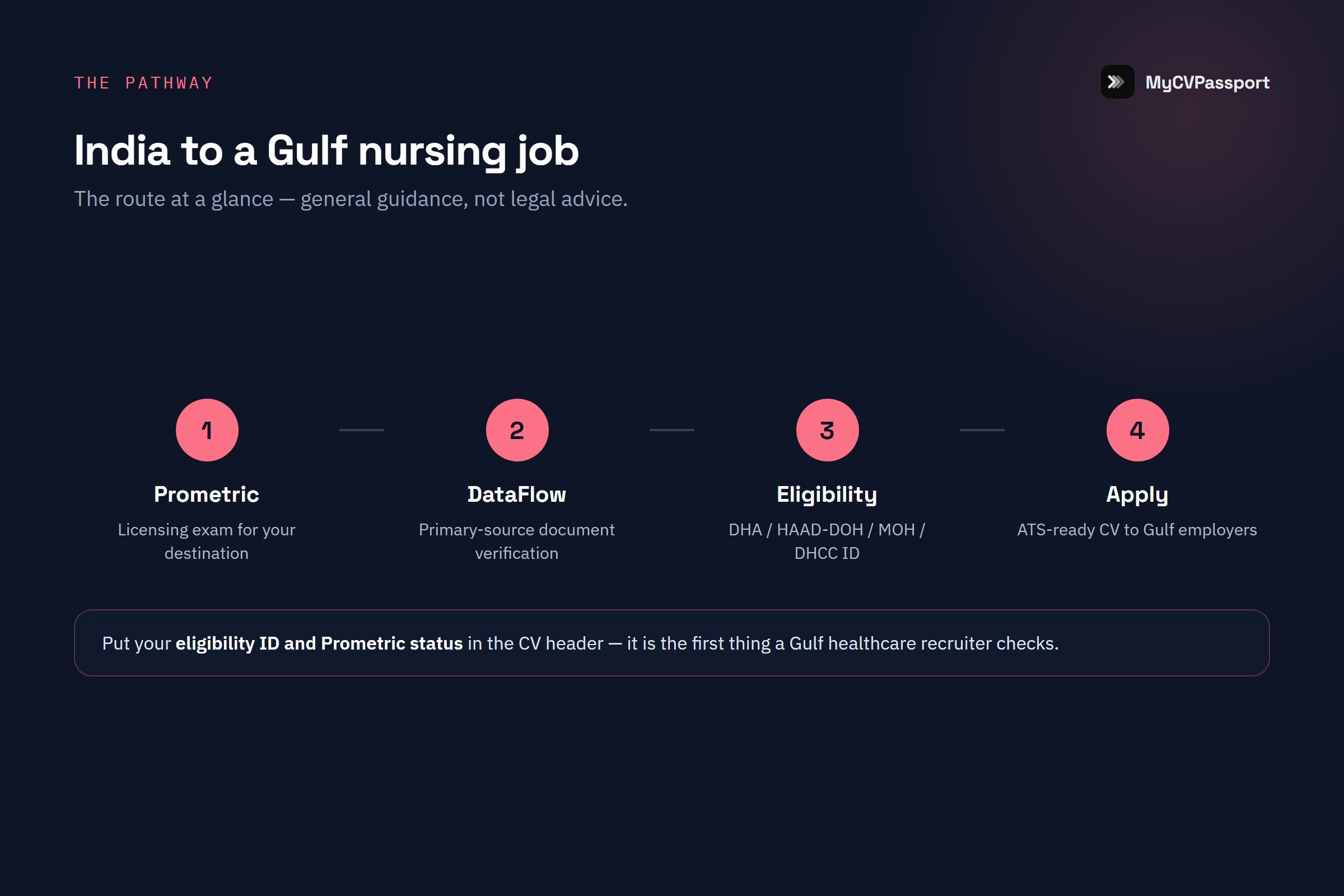
Gulf healthcare hiring runs on regulator licensing exams and primary-source verification. Depending on the emirate or country, that can mean a health-authority licence such as DHA, HAAD/DOH, MOH or a free-zone body like DHCC, usually via a Prometric exam, plus DataFlow primary-source verification of your credentials. Recruiters filter hard on these terms, and so does the ATS.
State exactly where you stand, in plain words. For example:
Eligibility: Prometric (DHA) — passed, Jan 2026. DataFlow verification — in progress. INC / State Nursing Council registration — active. Passport valid to 2031. Available to relocate within 30 days.
If you have not started a specific exam yet, say so honestly — "DataFlow: ready to initiate" is better than silence. Recruiters know the sequence and will not penalise a clear, current status. What they cannot work with is a CV that hides it.
One note: exam and licensing rules change and vary by authority. Treat everything here as general guidance for how to present your status, not legal or immigration advice — always confirm current requirements with the relevant health authority or your recruiter.
Section 2 — Professional summary (copy-paste example)
Three or four lines, directly under the header. No objective statements, no "seeking a challenging role". Lead with your title, years of experience, specialty and eligibility. Pack it with the keywords a Gulf JD uses.
Here is a copy-paste summary for a staff nurse — swap the specifics for your own:
Registered Staff Nurse with 4 years of acute-care experience across ICU and Med-Surg wards in tertiary hospital settings. BLS and ACLS certified, skilled in critical patient monitoring, EMR documentation and multidisciplinary care. DHA Prometric passed; DataFlow verification in progress. Indian national, passport valid, available to relocate to the UAE within 30 days.
Notice what it does: title, years, specialties, certifications, systems, licensing status, nationality and availability — all in four lines. Both the ATS and a busy recruiter get everything they need instantly.
Section 3 — Clinical skills matched to the job description
This is where you win or lose the keyword match. The ATS compares your skills against the JD. If the posting says "ventilator management" and your CV says "handled critical patients", the software may not connect them. Mirror the JD's language — truthfully.
Group your clinical skills so they are easy to scan and easy to parse:
- Specialties: ICU, Emergency, Med-Surg, Paediatrics, OT, Dialysis — list only what you have genuinely worked.
- Life support and certs: BLS, ACLS, PALS, NRP — with certifying details in the certifications section.
- Clinical procedures: IV cannulation, wound care, ventilator management, catheterisation, medication administration, ECG monitoring.
- Systems / EMR-HIS: electronic medical records, hospital information systems, e-prescription and documentation tools (name the category, not a branded product).
- Patient load: state your typical patient-to-nurse ratio (for example, managed 6–8 patients per shift) — Gulf employers read this as capacity and competence.
- Standards: infection control, patient safety protocols, quality and accreditation-standard documentation.
Read the actual job description before you finalise this section. If three postings all mention "triage" and "electronic documentation", those exact phrases belong on your CV — provided you have done the work.
Section 4 — Experience bullets: Bad vs Good
Most nursing CVs list duties: "responsible for patient care", "administered medication". Every nurse does that. Bullets that get interviews show scope, volume and outcomes. Quantify your patient-care work.
Use the pattern: action verb + what you did + scale or outcome. Compare:
- Bad: Responsible for patient care in the ICU.
- Good: Delivered direct critical care to 6–8 ventilated ICU patients per shift, maintaining continuous haemodynamic monitoring and zero documentation errors on medication administration.
- Bad: Handled emergency cases.
- Good: Triaged 40+ emergency patients per shift in a high-volume ER, prioritising acuity and reducing average door-to-assessment time through structured handover.
- Bad: Did wound care and dressings.
- Good: Managed post-operative wound care for a 30-bed surgical ward, contributing to a measurable drop in surgical-site infection incidents through strict aseptic technique.
- Bad: Worked with the medical team.
- Good: Collaborated in daily multidisciplinary rounds for a 20-patient caseload, escalating deteriorating patients early and supporting safe, timely discharge planning.
You do not need audited statistics. Reasonable, honest numbers from your own wards — beds, patients per shift, ratios, shift volumes — are enough to make the ATS and the recruiter take you seriously. If you are unsure how to quantify, our UAE CV Format 2026 guide breaks down the bullet formula in more depth.
Section 5 — Certifications, credentials and Indian nursing experience
Order matters here. Gulf recruiters scan certifications for compliance signals, so lead with what proves you can practise:
- Licensing / eligibility: Prometric exam status (DHA / HAAD-DOH / MOH), DataFlow verification status, health-authority eligibility letter if issued.
- Life support: BLS and ACLS first, with the certifying body and validity dates — these expire, and recruiters check.
- Registration: your INC and State Nursing Council registration number and status.
- Qualifications: GNM or BSc Nursing, institution type and year (name the qualification and city, not the specific college — keep it generic).
- Additional training: speciality courses, infection-control certificates, any accreditation-related training.
How to present Indian nursing experience for Gulf recruiters
Gulf recruiters may not recognise every Indian hospital name, and that is fine — you should describe your setting generically anyway. Instead of leaning on brand names, describe the environment in terms a recruiter anywhere understands: "500-bed multi-specialty tertiary hospital", "NABH-standard facility", "high-dependency unit". This tells them the scale and acuity of care you are used to.
Translate your Indian credentials into Gulf-legible terms. GNM and BSc Nursing map to Registered Nurse qualifications; state your INC registration plainly; convert your ward roles into the specialty language used in Gulf postings. You are not inflating anything — you are removing the friction that makes a recruiter give up on decoding your CV.
India nursing CV vs Gulf nursing CV
| Element | Typical India CV | Gulf ATS nursing CV |
|---|---|---|
| Format | Two-column, photo, tables | Single-column, no photo, no tables |
| Header | Name and contact only | Adds nationality, visa, passport, licensing eligibility |
| Licensing | Often omitted | Prometric / DataFlow / health-authority status up top |
| Summary | Objective statement | Keyword-rich professional summary |
| Experience | Duty list | Quantified, outcome-focused bullets |
| Skills | Generic list | Specialties, BLS/ACLS, EMR, patient ratios matched to JD |
| Length | 3–4 pages | 1–2 pages, focused |
| File | Scanned or image PDF | Text-based PDF the ATS can parse |
The single-column, text-based, eligibility-forward version is what survives the parser. If you are also weighing broader Gulf job-search strategy beyond nursing, read our resume for Gulf jobs from India guide alongside this one.
Build it without fighting the formatting
You could spend an evening wrestling Word columns that break the moment you export — or you can start from a template that is already single-column and ATS-tested. CVPassport gives you ATS-friendly nursing-ready templates, a live ATS score as you type, and AI bullet rewrites that turn "responsible for patient care" into quantified, recruiter-ready lines. It is free to start, and it is built around the India-to-Gulf corridor specifically.
Run your current CV through the free ATS checker first. If it scores low, you now know exactly why fewer callbacks were coming — and exactly what to fix.
Frequently Asked Questions
Do I need to clear Prometric and DataFlow before applying?
Not always before you apply, but the further along you are, the stronger your application. Many Gulf employers accept candidates who are eligibility-ready and complete Prometric and DataFlow during the hiring process, while others want verification well underway. State your exact status on your CV so recruiters can judge fit. Requirements vary by authority and change over time — this is general guidance, not legal advice, so confirm current rules with the relevant health authority or your recruiter.
How much experience do I need for a Gulf nursing job?
As a common baseline, many Gulf healthcare employers look for around two years of post-registration clinical experience, and specialty units such as ICU or ER often expect more. Fresh graduates can still apply to entry-level roles, but a well-quantified CV that shows real ward exposure matters more than the raw number of years.
Should I get my licence before or after landing a job?
The typical sequence is to become eligibility-ready — sit the relevant Prometric exam and start DataFlow verification — and complete final licensing once an employer is on board, since some steps are tied to a specific facility or emirate. The exact order depends on the health authority and the employer, so treat this as general guidance and verify the current process before you commit.
Do I need to put my photo on a Gulf nursing CV?
No. Photos, logos and image-based headers confuse the ATS and can push your CV into the reject pile before a human sees it. Keep the layout single-column and text-based. Your eligibility lines and quantified experience do the persuading, not a headshot.
How long should my nursing resume for Gulf jobs be?
One to two pages. Lead with your header, summary, licensing and skills so the most important signals land on page one. Trim old or unrelated roles to a single line. A focused two-page CV parses cleanly; a padded four-page one loses the recruiter's attention.
Will one CV work for every Gulf country?
The structure travels well, but the licensing line should reflect the specific authority you are targeting — DHA for Dubai, HAAD/DOH for Abu Dhabi, MOH federally, or the relevant body in other GCC countries. Keep one master CV and adjust the eligibility line and JD keywords per application.