How to Write a Resume With No Experience (2026 Guide)
You have never held a job, so the resume page stares back blank. Here is a step-by-step method to build a resume with no experience that still passes ATS and gets you interviews.
You open a blank document to build your first resume and freeze. The template asks for "Work Experience" and you have none. No job title, no company, no manager who can vouch for you. So you type something vague, feel like a fraud, and hit apply anyway — into a silence that never breaks.
Here is the truth nobody tells freshers: writing a resume with no experience is not about hiding the gap. It is about proving you can do the work using everything you have already done — projects, internships, college activities, volunteering, freelance gigs and certifications. Recruiters do not expect a fresher to have five years of experience. They expect evidence that you can learn, ship and show up.
And there is a second problem stacked on top: most fresher resumes never reach a human. Qualified candidates get filtered out every day — not because they are underqualified, but because their CV was not built to pass the system. This guide fixes both. By the end you will have a real resume with no experience that reads like an achievement story and passes the ATS scanner on the way in.
Why a resume with no experience gets rejected (it is not what you think)
Before we build, understand what you are up against. When you apply online, your resume usually hits an Applicant Tracking System (ATS) before any person sees it. The ATS parses your document into fields, scores it against the job description, and ranks you. If it cannot read your file cleanly, or if your keywords do not match, you are filtered out silently.
For freshers this is brutal, because you are already fighting to prove value with limited material. A fancy two-column template with icons and graphics — the kind Canva pushes — often scrambles inside the parser. Your carefully written content becomes garbage text the machine cannot score. You never even get to make your case.
So the first rule of a no-experience resume: use a clean, single-column, ATS-tested layout. Simple beats pretty every time, because pretty that cannot be read is worthless. Everything below assumes that foundation.
The right section order for a no-experience resume
An experienced professional leads with work history. You cannot, so you flip the structure to lead with your strongest evidence. Use this order:
- Contact information — name, phone, professional email, city, LinkedIn. No photo, no age, no marital status.
- Professional summary — 2 to 3 lines framing who you are and what you bring. This replaces the objective.
- Education — your headline asset as a fresher. Degree, institution, year, and relevant coursework or grades if strong.
- Projects — academic, personal or freelance. This is where you win. Treat each project like a job.
- Skills — technical and tools, matched to the job description keywords.
- Certifications — online courses, workshops, and credentials that prove initiative.
- Extras (optional) — volunteering, leadership, languages, awards.
Notice work experience is not a section here. Internships, if you have them, slot in above Projects or merge with them. The whole point is to front-load proof and never leave a blank "Experience" header screaming at the recruiter.
A quick word on the summary
Skip the tired "seeking a challenging role to utilize my skills" objective. It says nothing. Instead, state your field, your standout strength, and the value you offer. Example: "Final-year Computer Science student with hands-on experience building three full-stack web apps and a Google Data Analytics certification. Comfortable with Python, SQL and React, looking to contribute to a backend engineering team." Concrete, keyword-rich, done. For more patterns, see our resume summary examples for freshers.
What actually counts as experience (even when you have "none")
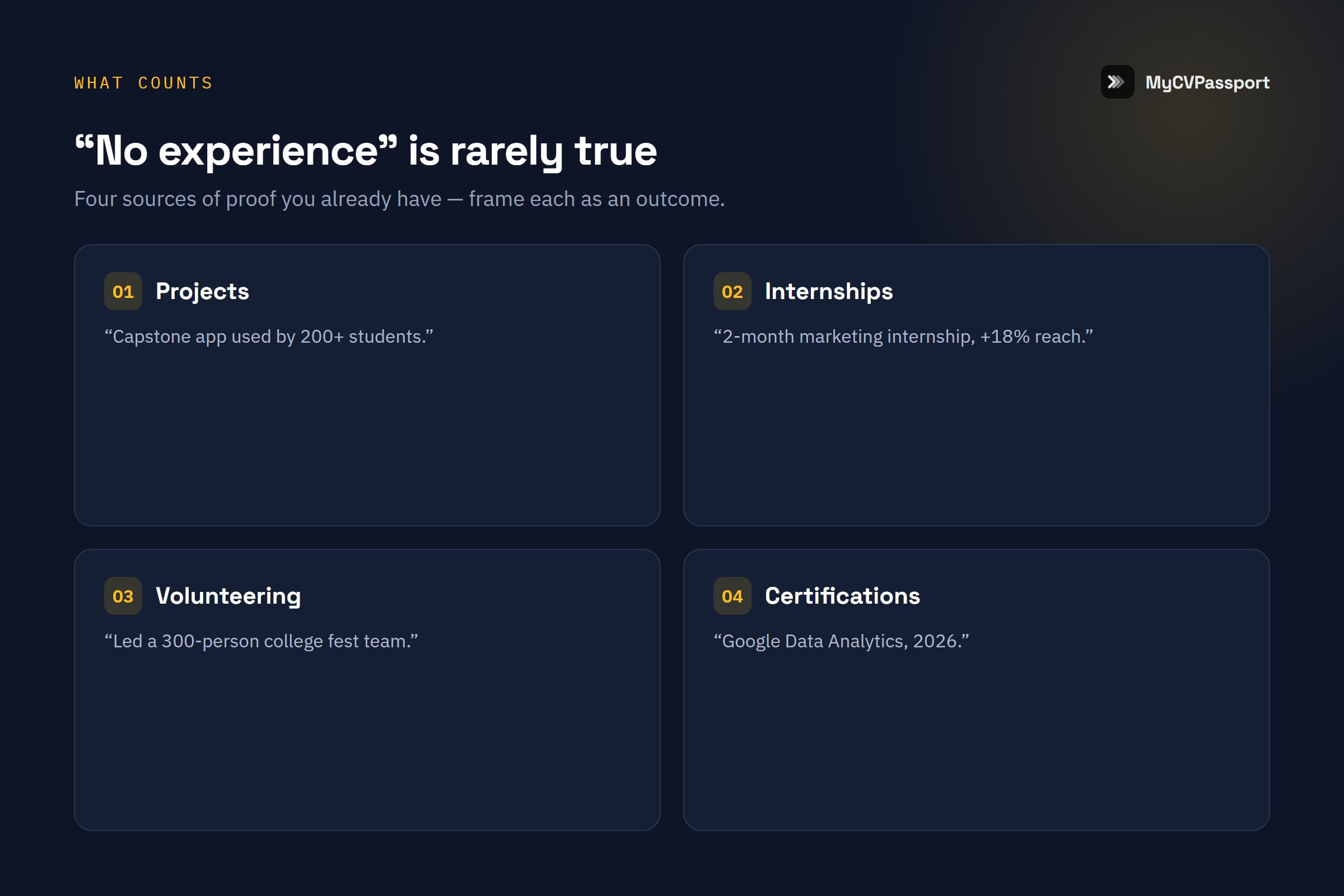
You have more raw material than you think. The mistake is dismissing it as "not real experience." A hiring manager does not care whether you got paid — they care whether you did the work and can prove the outcome. Here is how everyday things translate:
| You call it "nothing" | It actually demonstrates | Put it under |
|---|---|---|
| College final-year project | Technical skill, ownership, delivery under a deadline | Projects |
| Unpaid summer internship | Real workplace exposure and collaboration | Internships / Projects |
| Organising a college fest | Leadership, budgeting, coordination, communication | Extras / Leadership |
| Freelance logo or website you built | Client management, initiative, portfolio proof | Projects / Freelance |
| NSS or NGO volunteering | Teamwork, commitment, community impact | Volunteering |
| Online certification course | Self-motivation, current skills, initiative | Certifications |
| Class representative or club role | Responsibility, people skills, consistency | Extras / Leadership |
| Hackathon or competition | Problem-solving under pressure, teamwork | Projects / Awards |
Read that table again and list your own version. That list is your resume. You are not inventing experience — you are naming it correctly.
The bullet formula: turn activities into achievements
This is where most fresher resumes die. They describe what you were rather than what you did. The fix is a simple formula: Action verb + what you did + measurable result. Start with a strong verb, add specifics, and quantify wherever you can.
You do not need a job to quantify. Count anything — team size, budget, attendees, hours, percentage improvements, number of users, marks, ranks. Numbers make a fresher resume feel senior. Compare these before-and-after bullets:
- Bad: Participated in college fest.
- Good: Coordinated a 300-attendee college event, managing a team of 8 and a ₹40,000 budget, delivering it on schedule.
- Bad: Made a website for my project.
- Good: Built a responsive e-commerce site using React and Firebase, reducing page load time by 35% and used by 120+ test users.
- Bad: Was part of the marketing team in an internship.
- Good: Ran 5 Instagram campaigns during a 2-month internship, growing the page from 400 to 2,100 followers.
- Bad: Did volunteering work.
- Good: Led a team of 12 volunteers for an NGO literacy drive, teaching 60+ children across 8 weekend sessions.
- Bad: Good at communication and teamwork.
- Good: Presented 4 project demos to a panel of faculty, earning the top grade in a class of 90.
See the pattern? Every "good" version has a verb, a specific, and a number. You are not lying — you are refusing to undersell yourself. Go through every line of your draft and ask: what did I actually do, and can I attach a number to it?
Recruiters do not reject freshers for lacking experience. They reject them for failing to prove the experience they do have.
Transferable skills: your secret weapon
When you have no direct experience, transferable skills bridge the gap. These are abilities you built in one context that apply to the job you want. A student who managed a college club has learned coordination, deadline management and conflict resolution — all of which a real team needs.
Do not just list them as adjectives. Prove them through your bullets. "Leadership" on its own is a claim; "led a team of 12 volunteers" is evidence. Weave transferable skills into your project and activity bullets so the recruiter concludes them on their own. That is far more convincing than a skills soup at the bottom.
The transferable skills freshers underrate most
- Time management — juggling exams, projects and part-time work.
- Communication — presentations, group discussions, teaching or tutoring.
- Problem-solving — debugging code, fixing an event that went sideways.
- Collaboration — group assignments, team sports, club committees.
- Adaptability — learning a new tool fast for a project.
Match the job description so you pass ATS
Even a perfect resume with no experience fails if it does not speak the language of the job. The ATS scores you on how well your resume matches the job description. So the description is your keyword cheat sheet — use it.
Read the posting and pull out the hard skills, tools and terms it repeats: "Python," "SQL," "stakeholder communication," "Excel," "data analysis." If you genuinely have those skills, mirror the exact wording in your Skills section and bullets. If the JD says "customer service" do not write "client handling" — match the phrasing the scanner is looking for.
A warning: never keyword-stuff or claim skills you do not have. The goal is honest alignment, not gaming. If you know the skill, name it the way the JD names it. If you do not, that is a gap to close with a certification, not a lie to write. For the traps that get freshers filtered, read 10 resume mistakes that get freshers auto-rejected.
Certifications: proof of initiative
When you cannot show years on the job, certifications show you took the wheel yourself. A completed online course in your target field tells a recruiter you are motivated and current — two things freshers desperately need to signal. Free and low-cost certifications in data, marketing, design, coding and cloud are widely available and genuinely move the needle.
List them with the credential name and year. If a certification came with a project, mention the outcome — "completed a data analytics certification, including a capstone dashboard analysing 10,000 sales records." That single line does triple duty: initiative, a skill, and a quantified result.
Format rules that keep you out of the reject pile
You can write brilliant content and still lose to formatting. Freshers over-design because they feel the need to compensate for a thin history. Resist it. Follow these rules:
- Single column only — two-column layouts confuse ATS parsers.
- Standard fonts — Arial, Calibri, Georgia. No decorative fonts.
- No text inside images, tables or text boxes — the parser skips them.
- Clear standard headings — "Education," "Projects," "Skills."
- One page — you have no reason to run to two, so do not.
- Save and send as PDF unless the posting asks for .docx.
- No photo, no graphics-heavy header, no colour bars around text.
This is exactly why a purpose-built tool beats a generic template. CVPassport uses ATS-tested single-column templates, shows you a live ATS score as you type, and offers AI bullet rewrites that turn a flat line into an achievement. You can start free with no credit card and see your score before you ever apply.
Put it together: your build checklist
Here is the whole method in order. Work down it and you will have a finished resume with no experience in one sitting:
- Pick a clean single-column ATS template.
- Add contact info with a professional email.
- Write a 2 to 3 line summary naming your field and top strength.
- Lead with Education, including strong coursework or grades.
- List 2 to 4 projects, each with achievement-style bullets and numbers.
- Add internships or freelance work using the same bullet formula.
- Build a Skills section matched to the job description keywords.
- List certifications with year and any project outcome.
- Add volunteering, leadership or awards if space allows.
- Run it through a free ATS checker and fix what scores low.
That last step is not optional. Applying without checking your ATS score is applying blind. Run it, read the gaps, close them, then send.
Frequently Asked Questions
How do I write a resume with no experience at all?
Flip the structure to lead with your strongest evidence — education, projects, internships, volunteering and certifications — instead of a work history section. Reframe each item as an achievement using an action verb plus a measurable result. You are not hiding the gap; you are proving capability with what you have actually done.
What should a fresher put instead of work experience?
Use Projects as your anchor section, backed by internships, freelance work, college leadership roles, volunteering and certifications. Anything where you produced a result, coordinated people, or built something counts. Treat each of these like a job entry with bullets and numbers.
How long should a no-experience resume be?
One page. As a fresher you have no reason to spill onto a second page, and a tight single page reads as focused. If you are struggling to fill it, expand your projects with more detail rather than padding with fluff.
Do I need an objective or a summary?
Use a summary, not an objective. An objective talks about what you want; a summary states what you offer. In 2 to 3 lines, name your field, your standout skill, and the value you bring. It sets the tone and slips in keywords the ATS is scanning for.
How do I make my resume pass ATS as a fresher?
Use a single-column, ATS-tested layout, standard fonts and headings, and mirror the exact keywords from the job description where they honestly apply. Avoid images, tables and text boxes that parsers cannot read. Then run it through a free ATS checker and fix any low-scoring areas before you apply.
Is it okay to include personal or academic projects?
Absolutely — for a fresher, projects are often the single most important section. Academic, personal and freelance projects all show real skill and initiative. Describe them with the same achievement bullets you would use for a job, and quantify the outcome wherever you can.
Keep reading
- Resume summary examples for freshers
- 10 resume mistakes that get freshers auto-rejected
- Check your ATS score free
You do not have less to offer than the next applicant — you just have not named it correctly yet. Build the resume, run the score, close the gaps, and stop losing to a system you can beat. Start now, free.