Resume vs CV vs Biodata India: Which One Do You Actually Send?
Three words, three different documents — and sending the wrong one gets you filtered before a human ever reads your name. Here is exactly what resume, CV and biodata mean in India, and which one to send where.
You saw the job post. It said "send your CV." Your cousin told you to attach a biodata. The consultant on the phone asked for a resume. So which is it — and does it even matter?
It matters more than you think. The confusion around resume vs cv vs biodata in India is not just a vocabulary problem. Send the wrong format to the wrong employer and you look out of touch before your qualifications get a single second of attention. Worse, if that document is not built to pass an applicant tracking system, a machine rejects it and no recruiter ever sees you at all.
Qualified people get filtered out every single day — not because they are underqualified, but because the document they sent was the wrong type, the wrong shape, or unreadable to the software. This guide fixes that. You will learn what each of the three documents actually is, which one Indian employers expect in each situation, and how to build one that survives the filter.
Resume vs CV vs Biodata India: the 30-second answer
Before we go deep, here is the short version you can act on today:
- Resume — a tight 1-2 page summary of your skills and work history, tailored to one job. This is what most private-sector and IT employers in India want in 2026.
- CV (Curriculum Vitae) — a longer, complete record of your entire academic and professional life. Expected for academia, research, medicine, and most Gulf and international roles.
- Biodata — an older personal-data format that leads with date of birth, father's name, religion, and marital status. Still requested for some government, defence, and matrimonial contexts — and increasingly outdated for private jobs.
In everyday Indian usage, "CV" and "resume" are thrown around as if they mean the same thing. They do not. And biodata is a genuinely different animal. Let us break each one down so you never send the wrong file again.
What a resume actually is
A resume is a marketing document, not an archive. Its whole job is to convince one specific employer, in under two pages, that you can do one specific role. Everything irrelevant gets cut.
A modern Indian resume in 2026 leads with your name and contact line, a short professional summary, then your work experience in reverse-chronological order, followed by skills, education, and certifications. It is tailored — the projects and bullet points shift depending on the job you are chasing.
Bad: "Responsible for handling various tasks related to sales and customer coordination in the assigned region."
Good: "Grew regional sales 34% in 11 months by rebuilding the distributor follow-up process and cutting quote turnaround from 3 days to 6 hours."
See the difference? The good version leads with a number, names the action, and shows the result. Applicant tracking systems and human recruiters both reward specifics. Vague duty-lists get skimmed past.
What does NOT belong on a resume
- Date of birth, father's/husband's name, religion, caste, marital status — none of it. It adds bias risk and eats space.
- A photo, unless the role specifically requires one (some Gulf and hospitality roles do — see the UAE CV format guide).
- "Curriculum Vitae" or "Biodata" as a heading. Your name is the heading.
- Full paragraph blocks. Recruiters scan; use short, punchy bullets.
What a CV actually is
A CV (Curriculum Vitae — Latin for "course of life") is the complete record. Where a resume trims, a CV includes. Publications, conference talks, teaching experience, grants, full project lists, every degree and thesis — it all belongs, and length is not a problem. An academic CV can run four, six, even ten pages.
In India, you genuinely need the long CV format for a narrow set of fields: university and college teaching posts, PhD and research applications, medical and clinical roles, and scientific positions. For these, a two-page resume looks thin and incomplete.
Here is where it gets confusing: across the Gulf, the UK, and much of the international market, employers say "CV" when they actually mean what Indians call a resume — a tight two-page document. If you are applying to a Dubai or Abu Dhabi role and it asks for a "CV," do not send a ten-page academic dossier. Send a sharp two-page resume. Same word, different expectation.
Rule of thumb: in India, "CV" for academia = long and complete. "CV" from a Gulf or Western recruiter = a two-page resume. When unsure, send the tight version — nobody was ever rejected for being concise.
What a biodata actually is
Biodata (short for "biographical data") is the oldest of the three formats and the most personal. It historically leads with your date of birth, father's name, sex, religion, nationality, marital status, and permanent address — then lists education and experience almost as an afterthought.
It grew out of a time when personal identity mattered more than professional achievement on paper. You will still see biodata requested in a few places: certain government and public-sector application forms, defence and railway recruitment, and — most famously — marriage proposals. For a modern private-sector or IT job, sending a biodata signals you are working from an outdated template.
Bad (biodata sent for an IT job): A one-page sheet opening with "Date of Birth: 14/08/1998, Father's Name: …, Religion: …, Marital Status: Single" and your B.Tech listed halfway down.
Good (same person, resume format): Name and phone at the top, a one-line summary — "Backend developer, 3 years, Node.js and PostgreSQL" — then experience with measurable outcomes. The date of birth and father's name are simply gone.
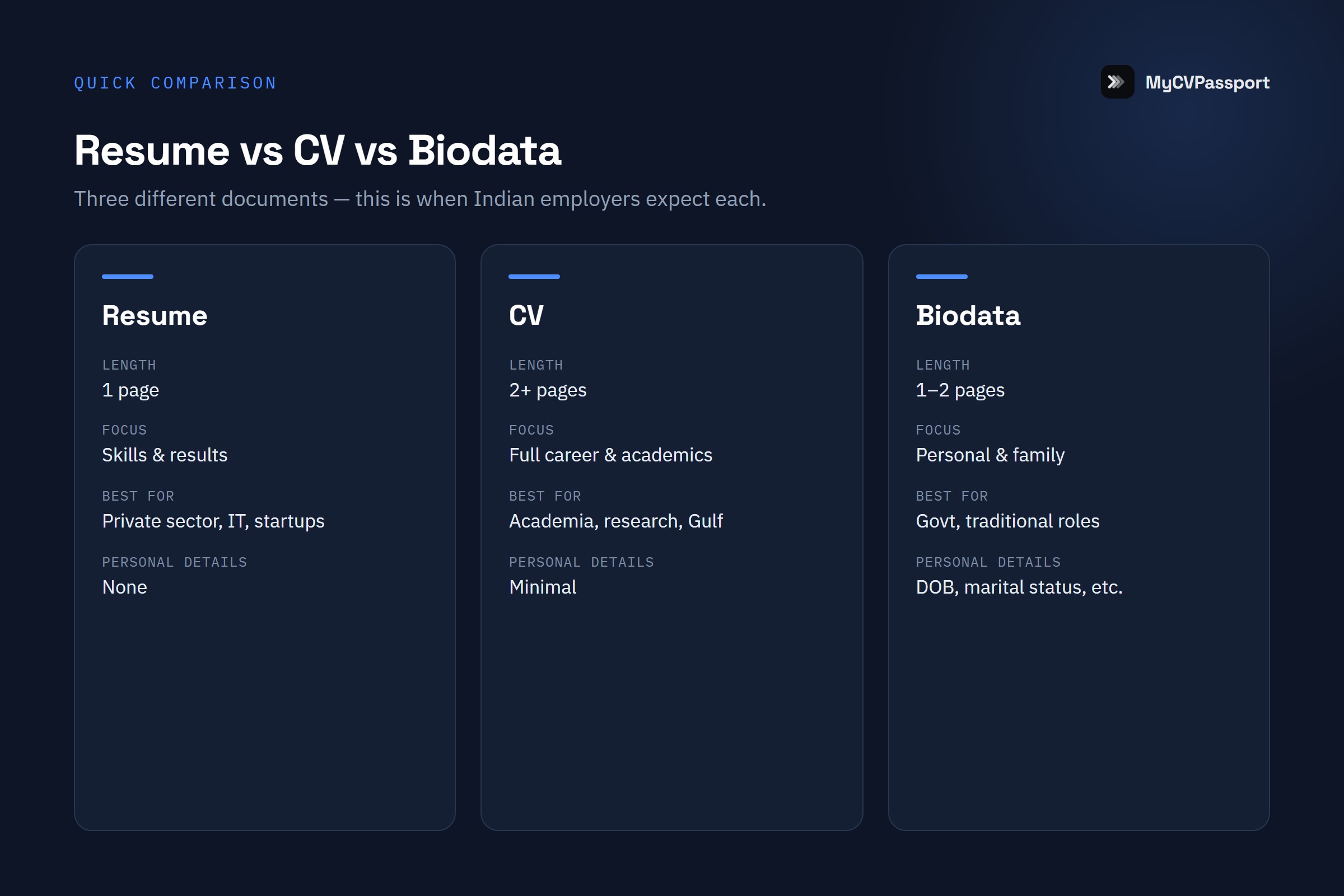
The comparison table: resume vs CV vs biodata
| Resume | CV | Biodata | |
|---|---|---|---|
| Length | 1-2 pages | 2-10+ pages | 1-2 pages |
| Leads with | Skills & experience | Academic record | Personal details |
| Tailored per job? | Yes, always | Rarely | No |
| Personal data (DOB, etc.) | Never | Optional | Front and centre |
| Best for (India) | Private, IT, campus | Academia, research, medical | Some govt/defence, matrimony |
| Best for (Gulf/intl.) | Yes (often called "CV") | Academia only | Never |
Which one do you send? A situation-by-situation guide
Private-sector and corporate jobs
Send a resume. One to two pages, tailored to the role, ATS-friendly single column, no personal-data header. This covers most jobs advertised on job boards and company career pages in India.
IT and software roles
Send a resume, and make it keyword-honest. IT applications almost always pass through an applicant tracking system that scans for skills like specific languages, frameworks, and cloud platforms. If the job needs "React" and "AWS," those exact terms must appear — spelled the way the job describes them. See best resume keywords for 2026 for how to do this without stuffing.
Campus placements and freshers
Send a resume. Colleges sometimes hand out a rigid template that looks half-biodata — resist padding it with personal fields. Lead with internships, projects, and skills. No experience yet? Read how to write a resume with no experience.
Government and public-sector applications
Follow the form. Many government recruitments provide a fixed proforma that is essentially a biodata — fill it exactly as specified, including DOB, category, and father's name if the form asks. Do not creatively redesign an official application form; here the biodata fields are mandatory, not optional.
Academic, research, and medical roles
Send a full CV. List publications, conferences, teaching, and every qualification. Length is expected. A trimmed resume reads as underqualified in these fields.
Gulf and international applications
Send a two-page resume even when the posting says "CV." Gulf recruiters use the word "CV" for what Indians call a resume. Some GCC roles do expect a photo, nationality, and visa status line — the UAE CV format guide covers exactly what to add and what to leave off.
The real gatekeeper: the ATS filter
Here is the part almost nobody tells you. Whether you call it a resume, CV, or biodata, if it goes through an online application it hits an applicant tracking system first. That software parses your document into fields — name, roles, dates, skills — and if it cannot read the layout, it drops or garbles your data. A garbled profile gets ranked low or auto-rejected.
This is why format choice and structure both matter. Common things that break the parse:
- Two-column layouts and sidebars — the machine reads left-to-right and scrambles the order.
- Text inside tables, text boxes, or images — often invisible to the parser.
- Fancy graphics, icons, and photos where they are not required — noise the parser cannot read.
- Non-standard headings like "My Journey" instead of "Work Experience."
- PDFs exported from design tools that flatten text into an image.
Copy-paste: a clean, ATS-safe skills line looks like this — "Skills: Java, Spring Boot, MySQL, REST APIs, Git, Docker, Agile." Plain text, comma-separated, real keywords, no graphics. That single line does more for your ranking than any design flourish.
CVPassport was built for exactly this problem. The templates are single-column and ATS-tested, so the parser reads every field in order. As you type, a live ATS score shows whether the software can actually read what you wrote, and the AI bullet rewrite turns a vague duty into a measurable achievement. You can start free with three templates and no credit card, and run the free ATS checker on whatever you already have.
Frequently Asked Questions
Is a resume and CV the same thing in India?
In casual conversation, most people in India use the words interchangeably, and for a private-sector job it usually does not matter which word you use — they both mean the tight two-page document. Technically, a CV is the long, complete academic record and a resume is the short tailored summary. If a college or research post asks for a CV, send the long version; for everything else, send a resume.
Should I put my date of birth and father's name on my resume?
No, not for a private-sector or IT resume. Those fields belong to the biodata format and add bias risk while wasting space. The only exception is an official government or defence application form that specifically asks for them — there, fill exactly what the form requires.
Is biodata still accepted for jobs in India in 2026?
For most private and IT jobs, no — sending a biodata makes you look out of date. It is still used in some government and defence recruitment forms and in non-job contexts like marriage proposals. For nearly every advertised corporate role, convert your biodata into a resume.
What format should I send to a Gulf employer?
Send a two-page resume even if the job says "CV" — in the Gulf, "CV" means resume. Some GCC roles also expect a photo, nationality, and visa status. Read the UAE CV format 2026 guide for the exact structure and the extra fields to include.
How long should my document be?
A resume should be one page if you have under five years of experience, two pages at most beyond that. An academic CV can run as long as your record honestly requires. A biodata is typically one to two pages. When in doubt, shorter and sharper wins — recruiters spend seconds, not minutes.
Will an ATS reject me for using the wrong word?
The word on the heading barely matters — the structure does. An applicant tracking system rejects documents it cannot parse: multi-column layouts, tables, images, and non-standard headings. Use a single-column, plain-text-friendly layout with standard headings and you pass, whether you call it a resume or a CV. You can confirm this with a free ATS score check before you apply.
The bottom line
Resume, CV, and biodata are not three names for the same thing. A resume sells you in two tailored pages, a CV records your full academic life, and a biodata leads with personal details from an older era. For almost every private-sector and IT job in India in 2026, you want a resume — and it has to be built so the ATS can actually read it.
Do not let the wrong format cost you an interview you earned. Build a clean, single-column, ATS-ready resume in minutes, then check its score before you hit send.