Data Analyst Resume for Freshers: Template + Examples
No work experience yet? You can still write a data analyst resume that clears the ATS and lands interviews. Here is a section-by-section template with copy-paste examples for freshers.
You have taught yourself SQL. You have built a dashboard or two. You finished a data analytics certificate and you are ready to work. So why does every application vanish the moment you hit submit?
Here is the uncomfortable truth: writing a data analyst resume for freshers is not about having years of experience you do not have. It is about proving you can do the work — and formatting that proof so a machine can actually read it. Most qualified freshers get auto-rejected before a human ever sees them. Not because they are underqualified, but because their resume was never built to pass the system.
Before your resume reaches a recruiter, it passes through an Applicant Tracking System (ATS) that scans for keywords, parses your sections, and scores you against the job description. Miss the format and you are filtered out silently. This guide gives you a section-by-section template with copy-paste examples so your data analyst resume gets read, scored, and shortlisted.
Build my data analyst resume free →
Why freshers get filtered out (and how to fix it)
The data field is competitive, and entry-level roles attract hundreds of applicants. Companies lean hard on ATS software to cut the pile. Your resume is being judged twice: first by a parser that extracts your text into a database, then by a keyword match against the role.
Three things get freshers rejected before a human reads a word:
- Fancy formatting that breaks parsing — two-column layouts, tables for your whole resume, text inside graphics, headers and footers. The ATS reads these out of order or drops them entirely.
- Missing keywords — you wrote "made charts" when the job says "data visualization." The parser matches literal terms, not intent.
- No proof of skills — listing "SQL" means nothing without a project that shows you queried a real dataset with it.
The fix is a clean single-column layout, standard section headings, real tool keywords, and 3 to 4 projects with numbers. Let us build it.
The fresher data analyst resume template (section by section)
Use this exact order. It matches how recruiters scan and how the ATS expects sections to appear:
- Contact info — name, phone, professional email, city, LinkedIn, portfolio/GitHub link
- Resume summary — 2 to 3 lines pitching your value as a fresher
- Skills — grouped, keyword-rich, tool-specific
- Projects — your strongest proof; 3 to 4 with quantified bullets
- Education — degree, institution type, graduation year
- Certifications — data analytics credentials
- Internships / coursework — if you have them
Keep it to one page. Save and export as PDF unless the application explicitly asks for .docx. A single-column PDF parses cleanly across almost every ATS.
Section 1: Resume summary example (copy-paste)
As a fresher you skip the "objective" and write a summary that leads with what you can already do. Here is a template you can adapt in seconds:
Detail-oriented data analyst with hands-on experience in SQL, Python, and Power BI through 4 end-to-end projects. Built dashboards and cleaned datasets of 50k+ rows to surface actionable insights. Google Data Analytics certified. Seeking an entry-level data analyst role to turn raw data into decisions.
Notice what it does: names the tools (keywords), quantifies the work (50k+ rows, 4 projects), states the certification, and closes with a clear target role. Swap the tools and numbers for your own. For more angles on this, see our resume summary examples for freshers.
Section 2: Skills — match real tools to JD keywords
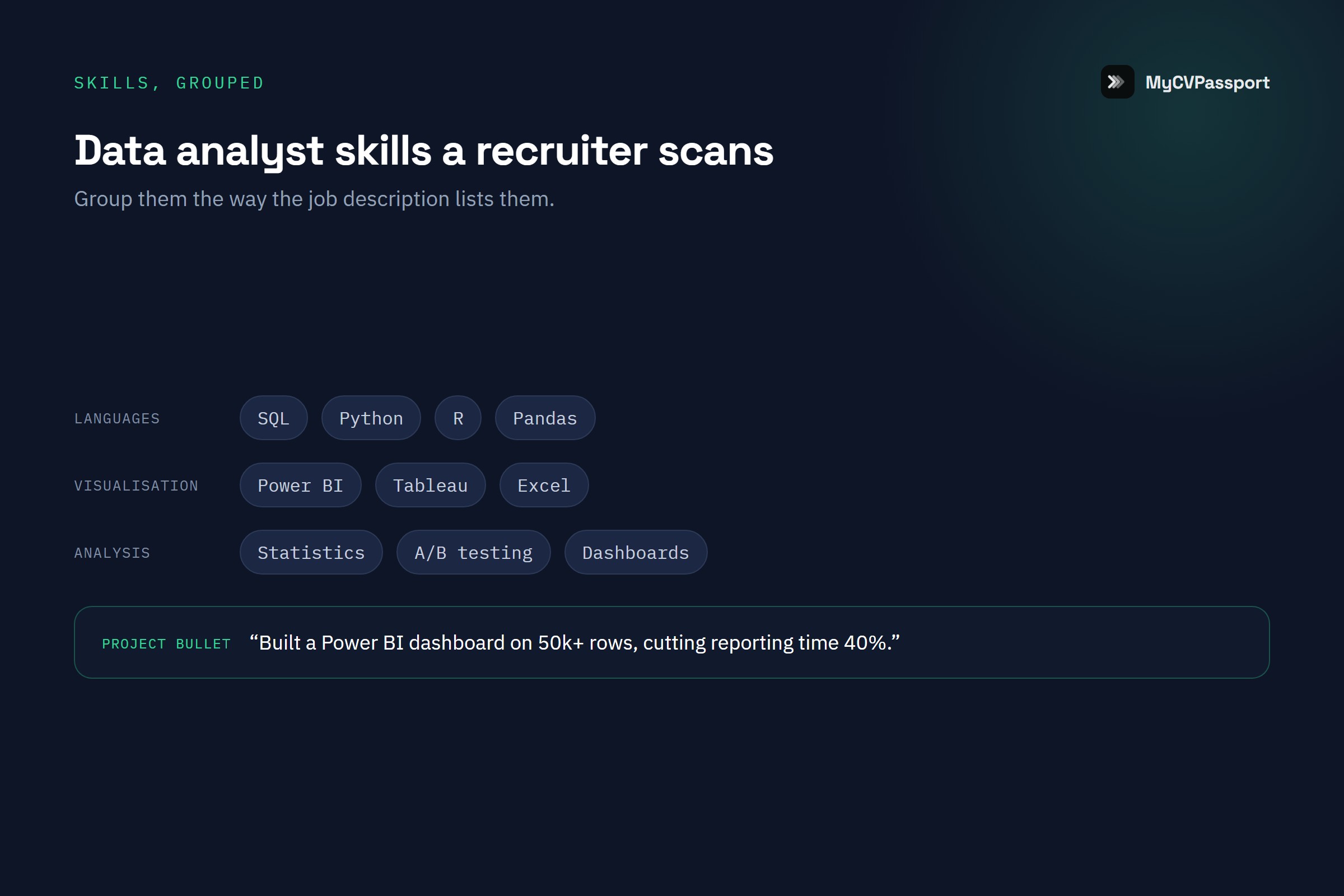
This is where fresher resumes win or lose the keyword match. List the actual tools, not vague categories. Group them so both the human and the ATS can scan fast. Here is a grouped skills table you can copy:
| Category | Skills to list |
|---|---|
| Databases / Querying | SQL, MySQL, PostgreSQL, joins, subqueries, window functions |
| Programming | Python, Pandas, NumPy, R (if used) |
| Visualization / BI | Power BI, Tableau, Excel dashboards, matplotlib, seaborn |
| Spreadsheets | Advanced Excel, pivot tables, VLOOKUP, Power Query |
| Statistics / Analysis | Descriptive statistics, A/B testing, regression, hypothesis testing |
| Workflow | Data cleaning, ETL basics, Git, Jupyter Notebook |
Rule of thumb: open the job description, highlight every tool and skill it names, and make sure the ones you genuinely know appear word-for-word in this section. If the JD says "Tableau" and you only wrote "data visualization," add "Tableau." The parser matches the literal term.
Never list a tool you cannot discuss in an interview. Keyword-stuffing skills you do not have gets you caught fast.
Section 3: Projects — Bad vs Good bullet examples
For a fresher, projects replace work experience. This is the most important section on your resume. The difference between a rejected bullet and an interview-winning one is specificity and numbers. Compare:
Project bullet 1 — SQL analysis
Bad: Used SQL to look at sales data and find trends.
Good: Wrote SQL queries with joins and window functions to analyse 80k+ sales records, identifying the top 3 products driving 60% of revenue and flagging a seasonal dip that informed restocking.
Project bullet 2 — Power BI dashboard
Bad: Made a dashboard in Power BI for a project.
Good: Built a Power BI dashboard analysing 50k+ rows of customer data, automating a manual report and cutting reporting time by 40% with interactive filters and KPIs.
Project bullet 3 — Python data cleaning
Bad: Cleaned data using Python and Pandas.
Good: Used Python and Pandas to clean and transform a 100k-row dataset, handling missing values and duplicates to raise data quality from 72% to 98% complete before analysis.
Project bullet 4 — Excel / statistics
Bad: Did analysis in Excel for a survey.
Good: Analysed a 5,000-response survey in Excel using pivot tables and hypothesis testing, uncovering a statistically significant preference (p < 0.05) that shaped the final recommendation.
The pattern for every bullet: [action verb] + [tool] + [what you analysed, with a number] + [outcome or insight]. Start with a strong verb (Built, Analysed, Automated, Queried, Cleaned, Visualised). Add the tool. Add the scale. Add the result. If you do not have a real number, estimate honestly — rows of data, percentage improvement, time saved, records processed.
Section 4: Education, certifications, internships and coursework
As a fresher, these sections carry weight — but present them tightly so they support your projects instead of padding the page.
Education
List your degree, field, institution type, and graduation year. If your degree is quantitative (statistics, mathematics, computer science, economics, engineering), that is a plus — but a non-technical degree is fine when your projects prove the skills. Add relevant coursework only if it is genuinely data-related.
B.Sc. in Statistics — 2026 Relevant coursework: Probability, Regression Analysis, Database Systems, Data Structures
Certifications
Data analytics certifications signal commitment and give you keyword-rich, credible lines. List them by name with the year:
- Google Data Analytics Professional Certificate — 2026
- Microsoft Power BI Data Analyst certification
- SQL or Python certification from a recognised course provider
Do not invent credentials. List only what you have earned or are close to completing (mark in-progress ones clearly).
Internships and coursework
If you interned anywhere — even unpaid or a college project with a real client — treat it like a job entry: role, organisation type, dates, and 2 to 3 quantified bullets in the same Bad vs Good style as your projects. No internship? Your projects section already carries the resume. Do not fake experience to fill a gap.
The ATS keyword list for data analyst roles
Weave these terms naturally through your summary, skills, and project bullets. Do not dump them in a hidden block — the ATS reads the whole document, and modern parsers flag stuffing. Use the ones that are true for you:
- SQL, MySQL, PostgreSQL, queries, joins, window functions
- Python, Pandas, NumPy, data cleaning, data wrangling
- Power BI, Tableau, data visualization, dashboards, reporting
- Excel, pivot tables, VLOOKUP, Power Query
- Statistics, A/B testing, hypothesis testing, regression, forecasting
- Data analysis, ETL, KPIs, insights, stakeholders, business intelligence
The single highest-impact move: read the exact job description and mirror its language. If it says "business intelligence," use that phrase. If it says "data storytelling," and you can back it up, use it. For a fuller list across roles, see the best resume keywords for 2026.
Formatting rules that keep the ATS happy
You can have perfect content and still get rejected on format. Follow these:
- One column, no tables for layout — a table for your skills grid is fine visually, but never build the whole resume in a grid.
- Standard headings — "Skills," "Projects," "Education." Do not get creative with "My Superpowers."
- No text in images or headers/footers — the parser often skips them.
- Standard fonts — Arial, Calibri, or similar. No decorative fonts.
- PDF export — unless the form asks for .docx.
- One page — for a fresher, more than one page usually means padding.
This is exactly why a purpose-built resume tool helps. CVPassport uses ATS-tested single-column templates, shows you a live ATS score as you type, and can rewrite weak project bullets into the quantified format above — so you stop guessing whether your resume parses.
Frequently Asked Questions
How do I write a data analyst resume with no experience?
Lead with projects, not experience. Build 3 to 4 real projects using SQL, Python, Excel, or a BI tool, and write each as a quantified bullet — tool, scale, outcome. Add a skills section that mirrors the job description and a certification if you have one. Projects with numbers are how a fresher proves capability without a job title.
What skills should a fresher data analyst put on a resume?
The core stack: SQL, Excel, Python (with Pandas), and at least one BI tool (Power BI or Tableau), plus basic statistics. List the specific tools you genuinely know, grouped by category, and match the wording to each job description. Depth on a few tools beats a long list you cannot defend in an interview.
Should I include a resume objective or summary?
Use a summary, not an objective. A 2 to 3 line summary that names your tools, quantifies your project work, and states your target role reads far stronger than an objective about what you "want to learn." Employers care what you can already do.
How many projects should I list?
Three to four strong, quantified projects is the sweet spot for a fresher. Each should show a different skill — one SQL-heavy, one visualization, one Python cleaning, one statistical analysis — so your resume covers the full analyst workflow without repeating itself.
Do certifications like Google Data Analytics help?
Yes. A recognised data analytics certificate adds credibility, keyword-rich lines, and signals commitment — especially valuable when you have no formal work history. But it supports your projects; it does not replace them. Recruiters still want to see what you built with the skills.
Is a free resume builder good enough for a data analyst role?
Yes, as long as it is ATS-friendly. What matters is clean single-column parsing, real keyword matching, and quantified bullets — not a paid template. CVPassport is free to start with 3 templates and no credit card, and it shows your ATS score live so you know your resume passes before you send it.