Cover Letter Format for Freshers in India (Free Template)
The exact cover letter format for freshers — header, salutation, hook, skills paragraph, and close — plus a free copy-paste template and two filled examples.
You have the degree. You have the internship or the college project. You sit down to apply, and the form asks for a cover letter — and your mind goes blank. So you copy something off the internet that starts with "To whom it may concern" and "I am writing to apply for the post advertised," and you send it off, and you hear nothing back.
You are not alone, and it is usually not your fault. The cover letter format for freshers that gets ignored is the one that sounds like everyone else — generic, begging, and stuffed with words that say nothing. Recruiters read hundreds of these. The ones that get read are specific, confident, and short.
This guide gives you the exact structure, a full copy-paste template with placeholders, two filled examples you can adapt tonight, an email version, and a bad-vs-good comparison so you can see the difference on the page. Let us fix this properly.
The cover letter format for freshers, section by section
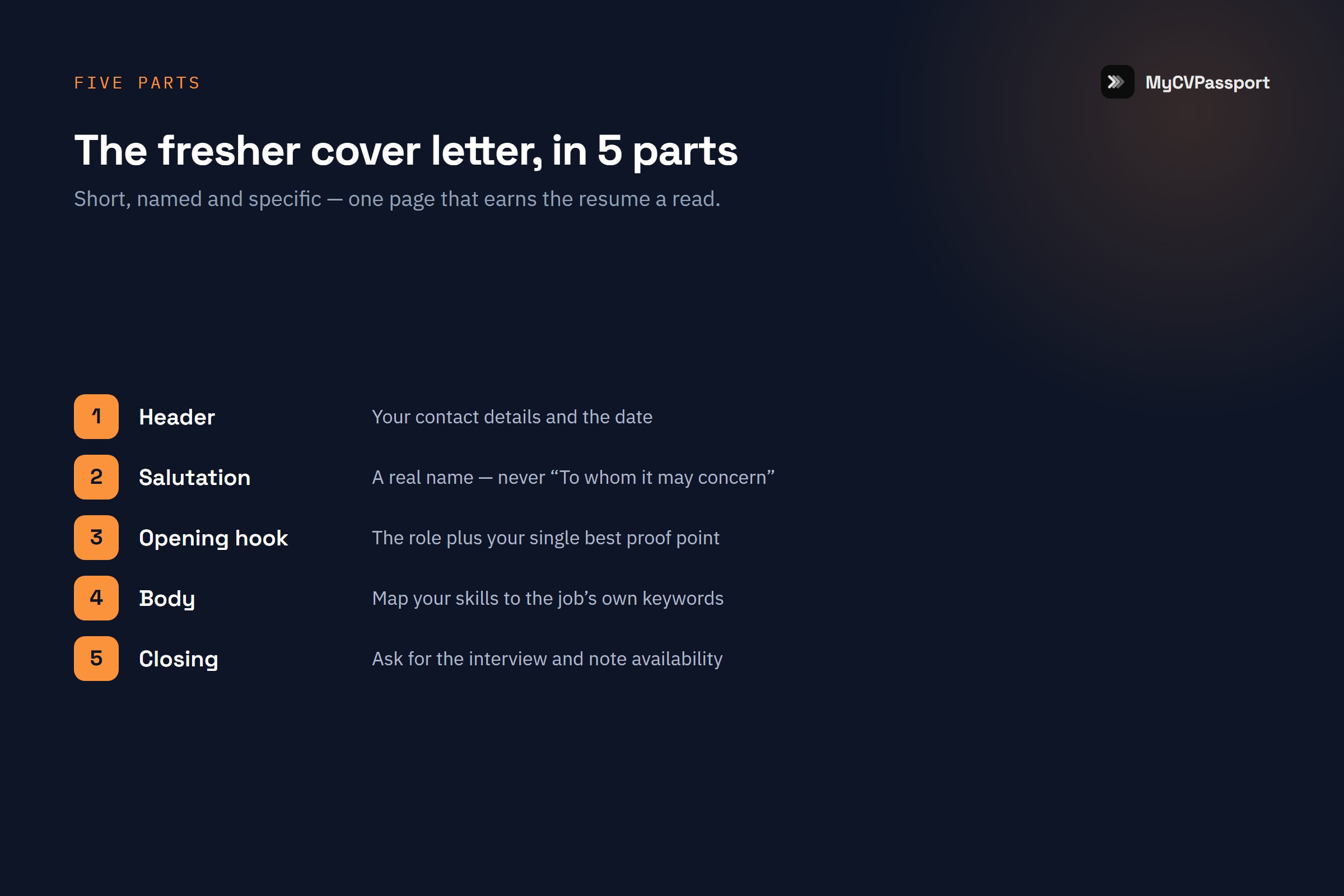
A cover letter is not a summary of your resume. It is one page that answers a single question the recruiter is silently asking: why should I read your resume next? For a fresher, that answer is built from five short blocks. Get the blocks right and the letter almost writes itself.
1. The header
Put your name, phone number, email, and city at the top. Add the date and, if you are sending a formal letter rather than an email, the company name and city below that. Keep it plain — no fancy fonts, no photo. If your resume header looks a certain way, match it so the two documents feel like one application.
2. The salutation — find a real name
"Dear Sir/Madam" and "To whom it may concern" tell the reader you did not bother to look. Spend five minutes finding a real name. Check the job post, the company's team page, or LinkedIn for the recruiter or the hiring manager. Then write "Dear Priya Sharma," or "Dear Mr. Rao,". If you genuinely cannot find a name after trying, use "Dear Hiring Team," — never "To whom it may concern."
3. The opening hook
Your first sentence decides whether the rest gets read. Do not open with "I am writing to apply for the position of..." — the reader already knows. Open with a specific reason you are a fit: a skill, a project result, or genuine interest in what the team does. Name the exact role and where you saw it, then land your strongest point immediately.
4. The body — map your skills to the job
This is the paragraph that does the work. Take two or three requirements from the job description and show, with evidence, that you meet them. As a fresher your evidence is your degree project, internship, coursework, freelance work, or a volunteer role. Use numbers wherever you can — "built a website that handled 200 users," "cut data entry time by half." One tight paragraph beats three vague ones.
5. The closing with a call to action
End by pointing forward, not by apologising. Restate your interest in one line, say you would welcome a conversation, and thank them. Then sign off with "Sincerely," or "Best regards," and your name. That is the whole cover letter format for freshers — five blocks, under 300 words, one page.
| Section | What goes in it | Length |
|---|---|---|
| Header | Name, phone, email, city, date | 3 to 4 lines |
| Salutation | Dear [Real Name], | 1 line |
| Opening hook | Role + strongest reason you fit | 2 to 3 sentences |
| Body | 2 to 3 requirements mapped to your evidence | 1 short paragraph |
| Closing | Interest + call to action + sign-off | 2 to 3 sentences |
The free copy-paste template
Here is the full template. Copy it, replace every [placeholder], and delete anything that does not apply to you. Keep it to one page.
[Your Name] [Phone] • [Email] • [City] [Date] Dear [Hiring Manager Name], I am applying for the [Job Title] role at [Company], which I found on [where you saw it]. As a recent [Degree] graduate with hands-on experience in [key skill], I was drawn to this position because [one specific reason tied to the role or team]. During my [internship / final-year project / coursework] at [place], I [what you did] and [result, with a number if possible]. This gave me practical experience in [skill 1] and [skill 2], both of which your job description highlights. I also [second piece of evidence — a project, a tool you learned, a responsibility you held], which taught me [relevant quality like attention to detail or working to deadlines]. I would welcome the chance to bring this energy to [Company] and to grow with your team. I have attached my resume and would be glad to discuss how I can contribute. Thank you for your time and consideration. Sincerely, [Your Name]
Notice what is missing: no "I am a hardworking and dedicated individual," no "kindly consider my humble application." Every line either names the role, proves a skill, or moves toward a conversation.
Worked example 1 — IT / software fresher
Here is the template filled in for a B.Tech graduate applying to a junior developer role. See how the evidence does the persuading.
Aditya Nair +91 98xxx xxxxx • aditya.nair@email.com • Pune 23 July 2026 Dear Ms. Kulkarni, I am applying for the Junior Software Developer role at your company, which I found on your careers page. As a recent B.Tech Computer Science graduate with hands-on experience in Java and React, I was drawn to this position because your team ships internal tools that real users depend on daily. For my final-year project I built a college event-management web app using React and Node.js that handled registrations for over 400 students across three fests. During a two-month internship I fixed 30-plus bugs in a live billing module and wrote unit tests that raised coverage from 45% to 70%. That work gave me practical experience in JavaScript, REST APIs, and Git-based collaboration — all of which your job description highlights. I would welcome the chance to contribute to your engineering team and keep learning in a production environment. My resume is attached, and I would be glad to walk you through my project code. Thank you for your time and consideration. Sincerely, Aditya Nair
Worked example 2 — BPO / customer support fresher
Not every fresher is an engineer. Here is the same structure for a customer-support or voice-process role, where communication and reliability are the real requirements.
Sneha Reddy +91 90xxx xxxxx • sneha.reddy@email.com • Hyderabad 23 July 2026 Dear Mr. Menon, I am applying for the Customer Support Associate role advertised on your job portal. As a recent B.Com graduate with strong spoken English and Hindi and part-time experience handling customers, I was drawn to this position because your team is rated for the quality of its support, not just its speed. While studying I worked weekends at a retail outlet where I handled 40 to 50 customer queries a day, resolved billing disputes calmly, and was chosen to train two new joiners on the point-of-sale system. That taught me patience under pressure, clear communication, and following a process without cutting corners — exactly the skills your job description asks for. I am comfortable with rotational shifts and pick up new software quickly. I would welcome the opportunity to bring this reliability to your support team. My resume is attached, and I am available for a call at your convenience. Thank you for considering my application. Best regards, Sneha Reddy
The email cover letter version
Most fresher applications happen over email, not a formal letter. When the job asks you to email your resume, the body of the email is your cover letter — keep it even shorter, three tight paragraphs, no header block (your signature covers that).
Subject: Application for Junior Software Developer — Aditya Nair Dear Ms. Kulkarni, I am applying for the Junior Software Developer role I found on your careers page. As a recent B.Tech CS graduate skilled in Java and React, I built a college event app used by 400+ students and fixed 30-plus bugs during a live internship. I have attached my resume and would be glad to share my project code. Thank you for your time — I would welcome a short call at your convenience. Sincerely, Aditya Nair +91 98xxx xxxxx • aditya.nair@email.com
Subject line rules
- State the role and your name — "Application for [Role] — [Your Name]." Recruiters filter by role; make it searchable.
- If the job post gives a reference code, include it exactly as written.
- Never leave the subject blank and never write just "Resume" or "Job" — both look like spam.
- Keep it under about 60 characters so it is not cut off on mobile.
Bad vs good — see the difference
The same fresher can send a letter that gets deleted or one that gets read. Here is what changes.
| Bad — gets ignored | Good — gets read |
|---|---|
| "To whom it may concern" | "Dear Ms. Kulkarni," — a real name |
| "Kindly consider my humble application" | "I built an app used by 400+ students" |
| "I am hardworking and dedicated" | "I raised test coverage from 45% to 70%" |
| Repeats the whole resume | Picks 2 to 3 job requirements and proves them |
| Two pages, dense blocks | One page, under 300 words, scannable |
| Same letter sent to every company | Names the role, the company, and one specific reason |
| Begging or apologetic tone | Confident, forward-looking call to action |
Keep it keyword-aligned with the job description
Here is the part most freshers miss. Your resume gets scanned by an applicant tracking system (ATS) before a human ever sees it. Qualified candidates get filtered out every day — not because they are underqualified, but because their CV was not built to pass the system. Your cover letter should complement that resume, not fight it.
Read the job description and note the exact words it uses for skills — "REST APIs," "rotational shifts," "data entry," "stakeholder communication." Use those same words naturally in your cover letter and your resume. When the two documents echo the language of the job, the whole application reads as a tight match instead of a hopeful guess.
Do not keyword-stuff — that reads as fake to a human and does nothing extra for the machine. Just make sure the two or three skills that matter most appear where they belong. If you want to see how your resume scores against a specific job before you send it, run it through a free checker first.
CVPassport builds ATS-tested, single-column resumes with a live ATS score and AI bullet rewrites, so the resume behind your cover letter actually gets through. It is free to start — three templates, no credit card. Pair a clean resume with the format above and you stop guessing why nobody replies.
Frequently Asked Questions
How long should a fresher cover letter be?
One page, and ideally under 300 words. For an email version, three short paragraphs. Recruiters skim — a fresher who says the right thing in five sentences beats one who buries it in five paragraphs. If it runs past one page, you are repeating your resume.
Do freshers even need a cover letter?
When the application asks for one, yes — skipping it can auto-disqualify you. When it is optional, a short, specific cover letter still helps you stand out because most freshers either skip it or send a generic one. As a fresher with a thin resume, the cover letter is your best chance to explain the fit in your own words.
Should I email the cover letter or attach it?
If the job post says attach it, send a PDF. Otherwise, write it in the body of the email and attach only your resume. Never send a blank email with two attachments and no message — that is the fastest way to get ignored. When in doubt, the email body version above works everywhere.
Can I use AI to write my cover letter?
Use it as a starting draft, not a final answer. AI can structure the letter and fix your grammar, but it does not know your specific project numbers, your real internship, or why you actually want this role. Always rewrite the specifics in your own voice — a recruiter can spot a fully AI-generated letter, and the generic ones all sound the same.
Can I use one cover letter for every job?
No — and this is the single biggest mistake. Keep the structure the same, but change the role name, the company, the opening reason, and the two or three skills you highlight for each application. A five-minute edit per job beats sending the same generic letter to 50 companies and hearing nothing.
What if I have no internship or experience at all?
Use your college projects, coursework, certifications, volunteer work, or freelance gigs as evidence. The body paragraph works with any of these — the point is to show a skill in action, not to list a job title. See our guide on how to write a resume with no experience for the resume side of this.