How AI is changing the job hunt, and how to build a CV that wins in 2026
7 min read · July 2026. AI is the first reader of your CV now. Here is what it rewards, what it quietly rejects, and how to build a CV that reaches a human.
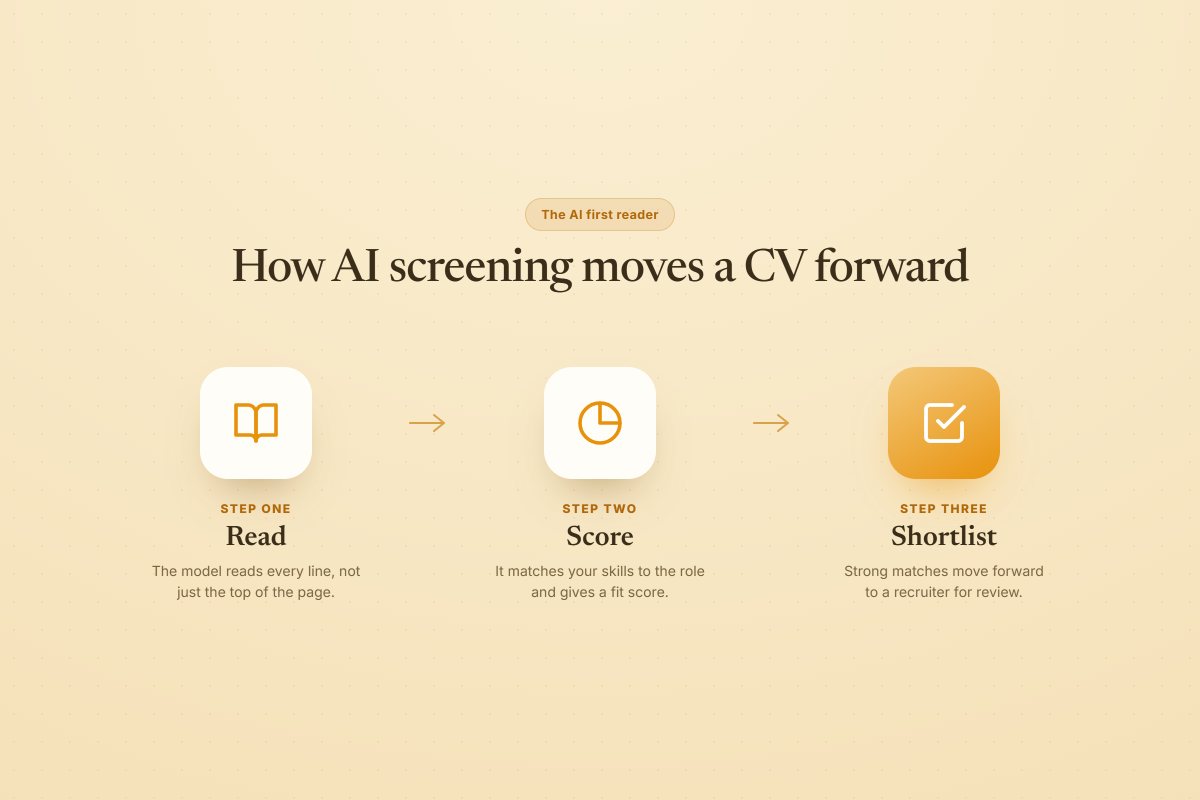
The way people get hired has quietly changed, and most job seekers have not caught up. A few years ago your CV was read first by a person. Today, in most medium and large companies, the first reader is software. An applicant tracking system sorts you, and increasingly an AI model reads your experience, scores how well you fit the role, and decides whether a recruiter ever sees your name. If your CV is not built for that first machine reader, you can be a strong candidate and still never reach a human.
This is not a warning to scare you. It is the single most useful thing to understand about job hunting in 2026, because once you know how the first reader works, you can build a CV that sails through it. This guide explains what AI screening actually does now, what it means for your CV, and how to build one that wins, whether you are applying at home or chasing a role in Dubai and the wider Gulf.
AI is now the first person to read your CV, except it is not a person
The numbers make the shift clear. Around 87 percent of companies now use AI somewhere in their hiring process, and roughly 65 percent of recruiters have put AI tools to work. More than 86 percent of recruiters say AI makes hiring faster, which is exactly why they use it. For an employer with hundreds of applicants per role, an AI model that reads every CV and ranks the strongest first is not a luxury, it is the only way to keep up.
For you as a candidate, that changes the job. You are no longer only trying to impress a hiring manager. You are first trying to be understood correctly by a model that reads your CV in seconds, matches it against the job description, and forms a verdict. A brilliant career told in a messy or vague document will be read as a weak one. A clear career told in a structured, keyword aware document will be read as a strong one. The gap between those two outcomes is often just formatting and wording, not talent.
What AI screening rewards, and what it quietly rejects
Modern screening looks for a few things, and you can give it all of them without gaming anything.
It rewards clarity. The model needs to find your job titles, your skills, your tools, and your results quickly. A clean structure with obvious sections, standard headings, and a readable layout helps it map your experience correctly. Heavy design, columns, images, and unusual fonts often confuse the parser, so the safest premium look is a clean one.
It rewards the right words. Every job description carries the language of the role. If a posting asks for project scheduling, a CV that says project scheduling will match more strongly than one that says kept things on track. This is not stuffing keywords, it is describing your real work in the words the role actually uses. The best CVs mirror the vocabulary of the job without inventing anything.
It rewards evidence. Numbers, outcomes, and specifics read as strength to both a model and a manager. Led a team reads as fine. Led a team of nine and cut delivery time by a fifth reads as proof. Wherever you can attach a figure to a claim, do it.
It quietly rejects vagueness, clutter, and mismatch. A CV that never names a tool, never quantifies a result, and never uses the language of the role can still describe a great candidate, but the first reader has nothing concrete to grab, so it scores low and moves on.
Why this matters even more for Gulf jobs from India
If you are applying from India for roles in Dubai, Abu Dhabi, Qatar, or Saudi Arabia, the first reader problem is bigger, not smaller. Gulf employers in 2026 are actively hiring Indian professionals across construction and infrastructure, engineering, logistics, and hospitality, from civil and mechanical engineers and project managers to skilled trades and site supervisors. These roles draw very large applicant pools, often from several countries at once, so the screening is heavier and the competition is wider.
When you apply across a border, you also lose the informal advantages that help locally, a familiar name, a shared network, a recruiter who already knows your last employer. Your CV has to do all of the convincing on its own, and it has to do it first for a machine. A document that clearly shows Gulf relevant experience, the right certifications, and results in the language of the role gives you a real edge over an equally qualified candidate whose CV is harder to read. In a corridor as competitive as India to Gulf hiring, a well built CV is not a nicety, it is the thing that gets you shortlisted.
How the CVPassport AI CV builder is built for exactly this moment
CVPassport was built around a simple idea, that a candidate should not lose an opportunity to a formatting problem. The AI CV builder is made for the way hiring actually works now, not the way it worked a decade ago.
It writes with you, from your real experience. Instead of leaving you staring at a blank page, the builder turns what you did into clear, strong, results led lines in the language recruiters and their AI tools expect. You bring the truth of your career, it helps you say it well.
It checks your CV the way an employer will. The built in ATS checker reads your CV the way a screening system does and shows you a real score with the reasons behind it, so you can see what a machine sees and fix the gaps before you apply, not after you are rejected. This is the difference between guessing and knowing.
It keeps you readable to humans too. A CV has to pass the machine and then win the person. The builder produces documents that are clean and professional on the page, so once you clear the first reader, the second one sees a candidate who looks the part.
And it is built for the corridor you are working in. For India to Gulf applicants, that means help presenting Gulf relevant experience and certifications in a way that both the screening system and the recruiter recognise.
Try the free CVPassport CV builder →
A short, practical checklist before you apply
Read the job description twice and note the exact words it uses for the skills and tools you have, then make sure those words appear naturally in your CV. Attach a number to your biggest achievements. Keep the layout clean and standard so the parser reads it correctly. Run it through an ATS checker and fix what the score flags. Tailor a fresh version for each serious application rather than sending one generic CV everywhere. None of this is gaming the system. It is simply telling the truth about your work in a form the first reader can understand.
The takeaway
AI has not made the job hunt colder, it has made it faster and, if you understand it, fairer. The candidates who win in 2026 are not always the most experienced, they are the ones whose CVs are clear enough that both a machine and a manager can see their strength in seconds. That is a skill you can learn, and it is one you can hand to a tool built for it.
If you want to see where your CV stands right now, build or check it free with the CVPassport AI CV builder, get your ATS score with the reasons behind it, and fix the gaps before your next application. Your next Gulf role could be one clean, well read CV away.